The Cloth Ledger: Dressing Outwards from a Yorkshire Woollen
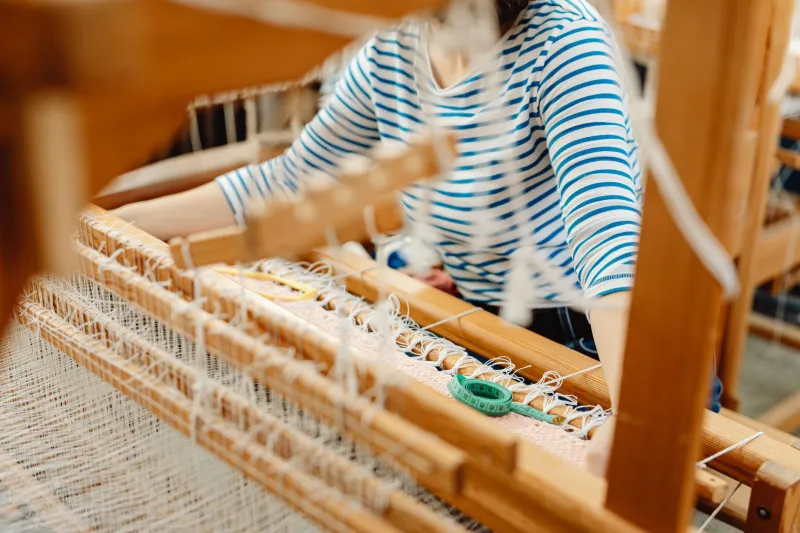
At Naomi Atkinson Design, a rail often begins with a length of cloth rather than a trend forecast. The method is simple: choose the textile, understand its weight and handle, then let the garments follow. This is not an argument for uniformity. It is a way of making a wardrobe that holds together. A recent studio note followed one cloth from a Yorkshire mill into a small set of outfits for a British climate. The cloth was a mid-weight woollen in a grey-green, woven in the Calder Valley and finished with a light brush. It sits at around 340 grams per square metre, heavy enough to hold a line, light enough to layer under a coat. The selvedge was clean; the handle was dry rather than soft; the colour shifted between lichen and slate in daylight. It was not a fashionable colour. It was a useful one.
The cloth before the garment
The mill's finishing is the first design decision. A light brush raises the surface just enough to soften the edge of the colour without blurring the weave. Too much brushing and the cloth becomes cosy but shapeless; too little and it reads as suiting rather than outerwear. This particular finish gives the cloth a quiet surface, one that takes a seam well and does not compete with a knit or a shirt beneath it. Yorkshire's textile history is not a decorative reference here. The county's mills shaped towns such as Huddersfield and Halifax, and the specialist houses that remain in 2026 are often small, technical and deeply practical. They work with finishers, dyers and weavers in a short chain. That proximity matters. It means a cloth can be chosen for how it behaves in a UK winter, not only for how it photographs in a showroom.
What the cloth asks for
A cloth of this density does not want to be over-designed. It wants clean lines, room to move and a minimum of unnecessary seams. The first garment was a simple jacket with a straight cut, a two-button front and enough ease at the shoulder to take a fine-gauge knit. The second was an overshirt, slightly softer in construction, with patch pockets and a plain hem. The third was a straight trouser with a single pleat, cut from the same cloth but pressed to a sharper crease. That is the principle: one cloth can suggest a family of pieces, not a single look. The wardrobe follows the textile. A poplin shirt, a merino crew neck, a cotton T-shirt and a leather shoe are enough to make the cloth work across a week.
Dressing for a British climate
The UK does not have one climate; it has a series of small weather events. Layering is therefore a daily negotiation rather than a seasonal rule. The useful approach is to start with a base layer that manages moisture, add a mid-layer of merino or fine knit, and reserve the woollen for the outer or mid-outer layer. Allow two to three centimetres of ease at the shoulder if the jacket is to sit over a knit. Do not rely on a heavy coat to do all the work; a dense woollen jacket is often more adaptable than a padded outer layer on a damp, mild day.
For the weekday, pair the jacket with a cotton poplin shirt, the straight wool trouser and a plain leather shoe. A trench or raincoat should be roomy enough to go over the jacket without compressing the shoulder. For the weekend, take the overshirt, a merino crew neck, dark denim and a sturdy boot. The cloth is formal enough for a town errand but not so formal that it looks misplaced in a market or a park. For the evening, keep the jacket and exchange the shirt for a fine merino roll-neck. A fluid skirt in a dry-finish wool, or the straight trouser in a darker tone, will let the cloth remain the focus. The aim is not to build three separate outfits. It is to build one wardrobe in which the cloth can move.
Care notes for woollen cloth
Woollen cloth does not need frequent cleaning. It needs rest, air and a brush. After wearing, hang the garment on a broad hanger and leave it for twenty-four hours before returning it to the rail. Use a soft clothes brush in one direction to lift surface dust. Spot-clean marks promptly with a damp cloth and a mild wool detergent, working from the outside of the stain inwards. Dry cleaning should be sparing; it is a treatment, not a routine. Store clean garments in a breathable bag, check for moths at the change of season, and use cedar or lavender with restraint. Fold knits; hang tailored jackets. Repair loose buttons and small seams before they become large ones. A wool garment worn twice a week can last for years if it is rested and aired. The point is not preservation for its own sake. It is to let the cloth develop a patina without losing its shape.
The discipline of cloth first
Cloth first is a discipline. It asks the wearer to choose fewer pieces, to understand weight and finish, and to let colour and texture do the work that logos and novelty usually do. In a British wardrobe, that discipline is not austere. It is practical. A Yorkshire woollen in a quiet grey-green can carry a coat, a jacket, a trouser and an overshirt without becoming a uniform. The wardrobe that follows is smaller, slower and more coherent. That is the ledger: cloth at the top, garments beneath it, and the daily outfit as the final entry.