The Break, Reconsidered: Hemming Trousers for Wet Pavements and Warm Rooms
There is a particular moment, somewhere between the second week of November and the first hard frost, when a pair of trousers stops behaving as it did in the fitting room. The cloth, which hung so obediently under shop lighting, begins to gather at the shoe. The hem, marked in a warm interior, meets a wet pavement and returns home a centimetre lower in effect than it was when it was pinned. It is not the trouser that has changed. It is the circumstances in which the trouser is now required to live.
The Fitting Room Lies Twice
A fitting room tells two convenient untruths. The first is about light. Bulbs placed high and slightly behind the customer flatten shadow, which flatters a break and conceals how a hem actually sits over a shoe. The second is about posture. We stand still, shoes clean, floor dry, and the hem is judged in a state of stillness that no British high street will permit for long.
A hem is a moving part. It swings, catches, lifts and settles again. The question is not where it rests in a photograph but where it travels when its wearer walks to the bus stop, climbs a stair, sits on a train and steps around a puddle. Judged only at rest, a trouser can be perfectly correct and still be wrong.
What November Does to a Hem
November in the UK is a month of contradictory surfaces. Pavements are wet but not reliably cold; interiors are warm but not reliably ventilated. A trouser is asked to be both protective and presentable within the same hour.
Wet ground alters the arithmetic of a hem in two ways. First, spray. A full break that brushes the shoe in dry weather will, on a wet pavement, collect moisture along its edge, darkening the cloth and stiffening it as it dries. Wool, flannel and cavalry twill take this less gracefully than a tightly woven worsted; a soft brushed finish, once wetted and dried at the hem, tends to look tired before the rest of the garment has begun to age. Second, weight. Water adds mass to cloth, and mass pulls. The hem hangs lower, the break deepens, and a trouser that was cut to skim the shoe begins, by mid-afternoon, to sit upon it.
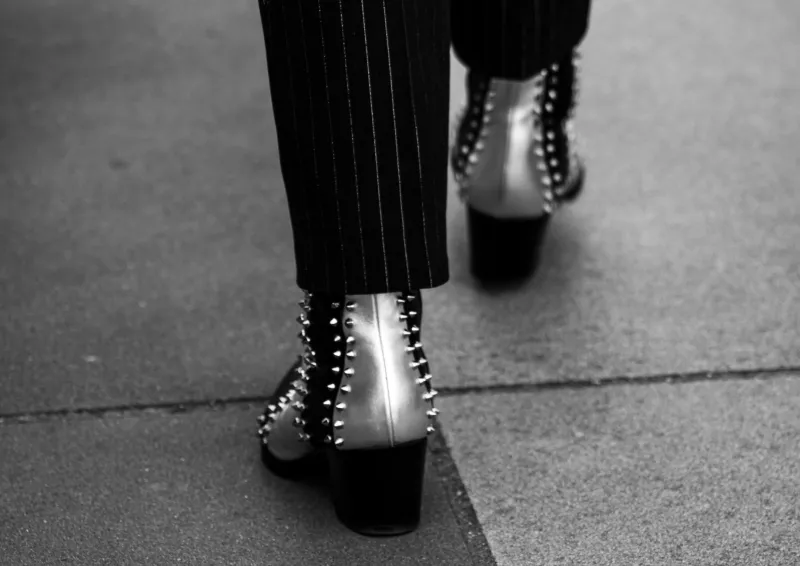
There is also the matter of the boot. A shaft rising above the ankle changes the silhouette entirely. A hem intended to fall cleanly over a low shoe may catch on the top of a boot, ride up at the back, and produce the small, persistent aggravation of cloth that will not settle. The fix is rarely a matter of taste; it is measurement.
The Sock Gap and the Overheated Interior
The opposite failure is equally common in a British winter. In the pursuit of a clean, unbroken line, a hem is cut short. This looks admirable in a warm room and becomes untenable out of doors, particularly when a trouser is worn with a shoe rather than a boot and the wearer sits down. The sock gap is not a stylistic quibble; it is a draught.
The remedy is not simply to lengthen every hem. It is to decide where the trouser will spend its hours. A pair worn chiefly to an office, carried through a short outdoor walk and then worn indoors for eight hours has a different brief from a pair worn on a Saturday of errands, market queues and wet pavements. The first can afford a marginally cleaner line, provided the sock is taken seriously. The second should be allowed a little more cloth and a little more forgiveness.
Overheated interiors complicate the calculation further. In a room at twenty-three degrees, a heavy wool trouser softens and loses some of its shape; the hem, relieved of stiffness, drapes more heavily. A break judged in a cold studio may read as excessive by two o'clock in a meeting room. This is not an argument for cutting short. It is an argument for judging in the conditions the garment will actually meet.
Turn-Ups, Grit and the Weight of Water
A turn-up is often defended on aesthetic grounds and criticised on practical ones, and both positions have merit. In November, the practical objection sharpens. A deep turn-up on a wet pavement gathers grit, salt and fine road debris into its fold, where it abrades the cloth and is difficult to brush out without working it further in. On a long trouser worn over a boot, the turn-up can also hold moisture against the hem line for longer than a plain finish would.
None of which makes the turn-up wrong. It makes it a choice with a season attached. A shallow turn-up of three to four centimetres, on a closely woven cloth, worn chiefly indoors and on dry days, remains entirely reasonable. A deeper turn-up on a soft flannel worn daily through a wet winter is a decision that will show by February.
A Studio Method for Settling the Hem
The method used in the studio is deliberately unglamorous, and it takes an hour rather than ten minutes.
Bring the footwear. Not a representation of it, and not a photograph, but the shoe or boot the trouser will actually be worn with, including the sock.
Wear the trouser for twenty minutes before judging anything. Cloth needs time to settle over the hips and knees; a hem marked on a freshly donned trouser will almost always be too short.
Walk two hundred paces, indoors and out. Watch the hem from behind as well as in front. Note whether it lifts, catches or drags. Note where the break forms, and whether it holds that shape after the walk.
Sit down. Cross the legs. Check the sock gap and the drape over the knee. A hem that behaves standing and misbehaves seated has not been judged.
Judge in daylight, near a window, with the coat on. A hem that reads well alone can look mean beneath a heavy overcoat; the coat changes the proportion of everything above it.
Allow one centimetre for settling, and check the cloth's shrinkage behaviour before cutting. Then pin, leave the trousers hanging overnight, and try again the following morning. If the hem is still right after a night on the hanger, it is likely to remain right after a winter on the pavement.
The Argument for Deciding Now
The temptation, in a month of changeable weather, is to wait. But a hem left too long for a season is not neutral; it is quietly deteriorating at the edge, collecting water and grit while the decision is deferred. And a hem cut too short in October cannot be recovered in January without a visible remodelling.
The better course is to decide in November, with the boots on and the pavement wet, and to accept that the correct hem is the one that survives an ordinary day rather than the one that photographs best in a warm room. Trouser length is not a matter of taste alone. In a British winter, it is a small piece of practical tailoring, and it deserves to be judged as such.