The Reaching Sleeve: Fitting a Winter Coat at the Wrist
Photo: Jeremy Bolwell , CC BY-SA 2.0, via Wikimedia Commons
Of all the measurements taken during a coat fitting, sleeve length is the one most often settled too early. Shoulder and hem receive careful attention because they are visible from across a room. The sleeve, by contrast, is judged in a standing position, arms hanging, mirror straight ahead. It is a tidy view, and a misleading one. A British winter coat is rarely worn in that posture. It is worn reaching for a handrail, gripping an umbrella, pulling on a glove, and waiting at a bus stop with hands pressed into pockets. Each of these actions changes the relationship between cuff and wrist by a centimetre or more.
The Static Mirror Is a Poor Witness
A coat can appear perfectly proportioned when the wearer stands with arms at rest. The cuff sits where convention says it should, perhaps at the wrist bone or just below. But convention is not the same as performance. When the arm extends, the sleeve rides back. When the shoulder lifts, the cuff retreats further. When the hand closes around a strap, the wrist turns and the sleeve twists. What looked correct in stillness can become a gap of cold air at the precise moment the wearer needs coverage.
The studio therefore treats sleeve length as a dynamic measurement. It is not simply the distance from shoulder seam to cuff. It is the distance the cuff travels when the coat is asked to do something. This is especially true of winter coats, where the sleeve must accommodate not only the arm but also the layers beneath it and the accessories beyond it.
Gloves, Knit Cuffs and the Clearance Question
Gloves are the most obvious variable. A leather glove ends at the wrist; a knitted glove may extend further; a gauntlet may cover the lower sleeve entirely. The coat sleeve must decide how it will meet these forms. Too short, and a band of bare skin appears between cuff and glove. Too long, and the sleeve swallows the glove, bunching at the wrist and interfering with grip.
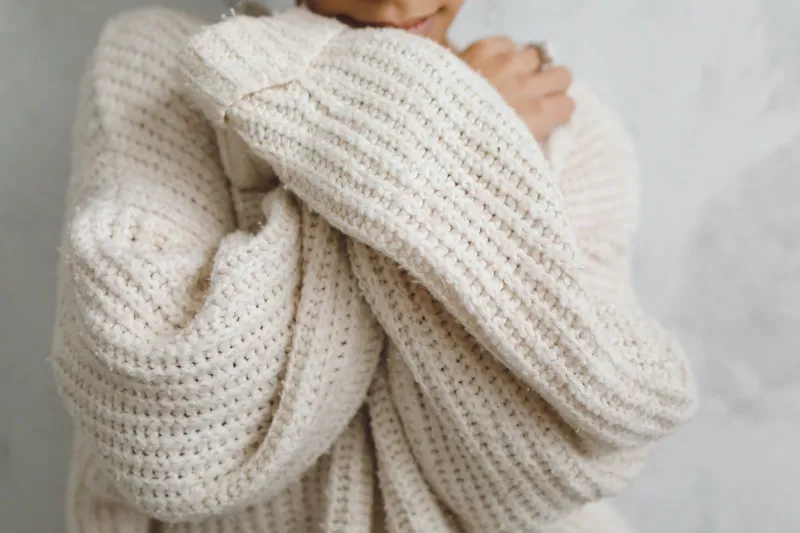
Knit cuffs introduce a second question. A ribbed cuff should sit close without compression. If the sleeve is cut too long, the knit folds back on itself and creates a bulky ring at the wrist. If it is cut too short, the cuff pulls away from the hand and leaves the glove to bridge the gap alone. The useful principle is clearance rather than coverage: the sleeve should allow a glove to meet it without either garment fighting the other.
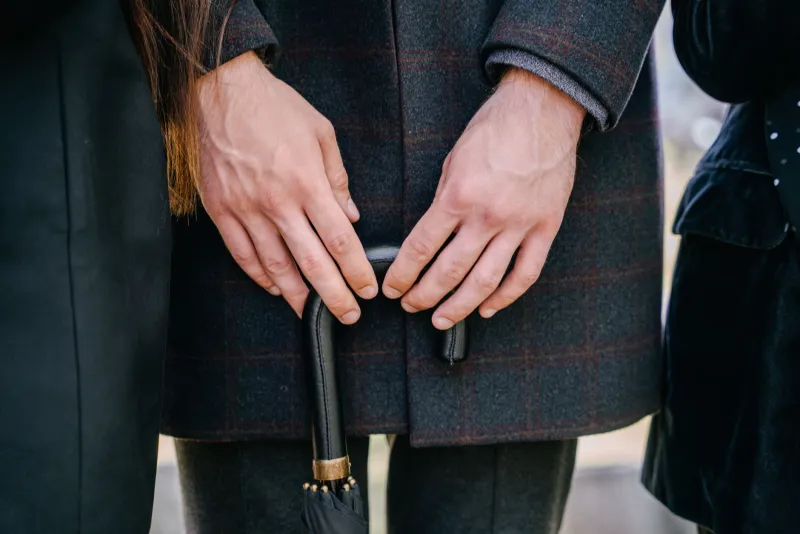
Umbrella handles add a third point of contact. A hand closed around a handle is not a hand at rest. The wrist angles, the forearm rotates and the cuff moves. A sleeve that clears the wrist adequately in the mirror may expose the glove when the umbrella is held at chest height. In a British winter, that is not a minor detail. It is the difference between a coat that feels composed in the street and one that requires constant adjustment.
Three Movements for the Fitting Room
A practical fitting does not require a bus stop inside the studio. It requires three movements, performed slowly and observed without flattery.
The first is the reach. The wearer should extend one arm forward as if taking a rail or opening a door. The cuff should remain close to the glove without pulling away from the wrist. If a gap appears, the sleeve is either too short or the shoulder is too restricted. The distinction matters, because lengthening a sleeve will not solve a shoulder that cannot move.
The second is the grip. The wearer should close the hand around an imaginary strap or umbrella handle, then rotate the wrist slightly. The cuff should follow the arm rather than stay behind. Any sense of tightness across the upper sleeve suggests that the coat is being asked to perform beyond its cut.
The third is the pocket. Hands should be placed into the coat pockets, not merely rested against them. This shortens the visible arm and pushes the cuff forward. A sleeve that looks elegant at rest can suddenly feel excessive. The question is whether the extra length forms a clean break at the wrist or collapses into a fold.
The Bus Stop Test
The bus stop is the honest fitting room. It asks the coat to stand still for longer than expected, to endure a cold wind, and to accommodate hands that would rather be in pockets. A sleeve that is a centimetre too short will be noticed there, not in the mirror. A sleeve that is a centimetre too long will be noticed when the wearer tries to take a phone from a pocket or tighten a glove.
The right length is rarely dramatic. It is the point at which the cuff meets the hand with enough room for a glove, enough structure to hold its line, and enough ease to allow the wrist to move. It may vary between coats: a wool overcoat may sit closer than a quilted piece, and a raglan sleeve may behave differently from a set-in sleeve. The measurement should follow the garment, not a fixed rule.
Alterations With Room to Move
When a sleeve is altered, the studio prefers to fit it with the intended glove or knit cuff at hand. A centimetre can be removed later; it cannot be added invisibly. The hem of a sleeve should also be finished with enough depth to allow a clean turn and a comfortable wear. A narrow allowance may look neat on the table, but it leaves little room for the movement that winter demands.
Sleeve length is not a decorative afterthought. It is part of how a coat behaves in weather. Judged in motion, at the wrist, it becomes less a matter of proportion and more a matter of trust: the coat will cover what it should, without asking the wearer to think about it again.