Rest, Weight and Warmth: The Pressing Bench as a Shaping Tool
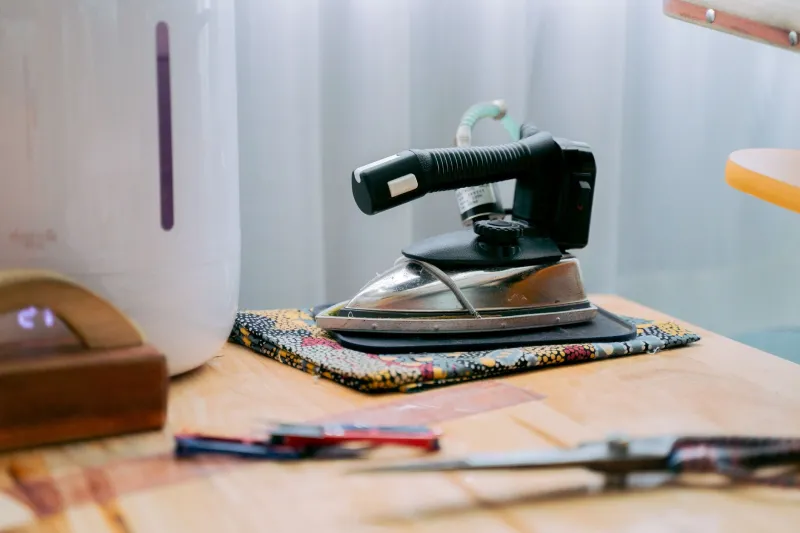
There is a moment in the studio, usually late on a November afternoon, when a coat stops reading as a set of joined pieces and begins to read as a garment. It seldom arrives through another row of stitching. It arrives under a damp cloth, with the iron held still and the steam counted.
Pressing is the least photographed stage of making a garment, and the stage most often performed at home as though it were laundry. The domestic iron is built for a domestic purpose: to remove creases from flat cloth. The tailor's iron is a shaping instrument, and the cloth beneath it is not flat. Everything useful about pressing follows from that distinction.
Pressing Is Not Ironing
The test is simple. If the iron is travelling, it is ironing. Ironing is a sideways motion carried out with pressure, and it does two things to wool: it flattens the loft out of the yarn, and it stretches the cloth along the direction of travel. On a straight run of cotton sheeting neither matters. On a shaped wool front, both are damage.
Pressing is a vertical action. The iron is placed, held, lifted and placed again. The cloth is moved under a stationary iron rather than the reverse. The weight of the soleplate does the work; the hand only guides and, where a seam needs to lie open, the fingertips or a clapper take over. A studio rule of thumb: the iron should leave the bench no more often than the cloth does.
What the Steam Is Doing
Wool is a hygroscopic fibre, which is to say it takes up moisture readily and gives it up slowly. Heat, moisture and a modest pressure allow the molecular chains within the fibre to move a little; when the cloth cools and dries, they settle into the position in which they dried. The shape is not made while the iron is on the cloth. It is made in the seconds after the iron has been lifted, and it is made properly only if those seconds are allowed to happen.
This is why a hurried press produces a garment that looks pressed on the hanger and rumpled by the second wearing. The fibre was never given time to set. It is also why over-steaming is a false economy: too much moisture swells the yarn, encourages felting at the seam line, and leaves the cloth soft when it should be settled. In hard-water areas, notably much of London and the south-east, a steam iron will also deposit mineral traces; the studio uses filtered or distilled water as a matter of course.
The Bench and Its Furniture
The pressing surface matters more than the iron. A hard board with a thin cover presses a flat plane into a three-dimensional garment, which is the origin of many of the faults described below. The studio bench is padded, and four pieces of equipment do most of the shaping.
The pressing cloth is the first. A linen or cotton square, wrung out until it is barely damp and no more, protects the face of the cloth from direct heat and from the shine that direct contact produces. A wet cloth is worse than a dry one: it spots wool and crushes the nap.
The tailor's ham is the second, and the most misunderstood. It is a firmly stuffed cushion with a curve approximating a shoulder, a hip, a bust. Seams pressed over that curve are set in a shape related to the body rather than to the table. A shoulder seam pressed flat will always fight the wearer; the same seam pressed over the ham will sit down quietly and stay.
A sleeve board allows a narrow tube to be pressed without creasing the parts that should remain round. A clapper, or a heavy wooden block, is used where a sharp, permanent edge is wanted, and withheld where it is not.
A Coat Under the Cloth
Take a British woollen coat, cut from a Huddersfield cloth of moderate weight with a soft, slightly irregular hand. The pressing sequence in the studio runs in the same order as construction, and no stage is left to the end.
Shoulder seams are opened over the ham, with the point of the iron and very little pressure, the allowance persuaded rather than beaten. The front edge and facing are pressed with a strip of paper or a folded remnant underneath, so that the edge of the allowance does not print itself into the face of the cloth. The hem is treated lightly, with the clapper rather than the soleplate, because a heavy hand at the hem produces a hard line that no amount of wear will soften.
The lapel is the useful case study. Its roll should be formed over the ham in a curve that continues the line of the chest, then left to cool undisturbed. Pressed flat, that roll disappears and cannot be recovered; the coat will thereafter break at the lapel line like a folded card. The difference between a good and a merely correct lapel is often a matter of thirty seconds of restraint.
The Trouser Leg and the Crease That Should Not Shine
On a worsted trouser leg the aim is a crease with a soft edge and no glaze. The leg is pressed on the inside first, seam allowances opened, and then laid on the board with the two halves of the leg matched precisely before the crease is set. Matching matters: a leg pressed half a centimetre out of register will twist as it hangs.
The cloth is then left to cool and dry before the leg is folded for storage. Trousers hung by the waistband overnight, so that residual moisture can leave, press better the second time than the first. A crease that has been set with a hard soleplate and no cloth will emerge glossy, with a bright line down the front of the shin that reads from across a room.
Reading a Cloth That Has Been Over-Pressed
A buyer can identify an over-pressed garment without turning it inside out. Look for a sheen on dark cloth, particularly at seam ends, pocket mouths and the seat, where the iron has been travelled rather than placed. Look for a flattened nap in patches, and for the faint impressions of seam allowances or buttons printed into the face. Take the cloth between finger and thumb: over-pressed wool feels thin and papery, with no loft and no spring.
More telling still is the behaviour of the cloth after a day's wear. Over-pressed wool loses its recovery. A crease set into the inside of an elbow will remain there; a sleeve head that should stand will collapse. A glaze is not reversible, because the fibre itself has changed; a mild flattening can sometimes be lifted with steam, a stiff brush and a long rest, but nothing restores loft that has been ironed out.
A Short Method
Press as you sew, never at the end. Work on the inside wherever the cloth allows. Keep the cloth barely damp rather than wet. Place the iron, count two or three seconds, lift, and move the cloth, not the hand. Let each stage cool before beginning the next. Test on a remnant before touching the garment, and never press over pins.
The cloth will remember what the iron has told it. The only question is whether the instruction was deliberate.