The Room That Lies: A Case for the Honest Mirror
Photo: PattayaPatrol, CC BY-SA 4.0, via Wikimedia Commons
There is a particular kind of November Saturday when the high street reaches its full pressure and the fitting rooms become, briefly, the most consequential rooms in the country. Behind a curtain, under a strip light, a coat is judged. It is judged quickly, and it is judged wrongly, and both the garment and the person wearing it are usually blamed for the error.
The mirror is rarely the culprit we name. It is simply the instrument, and like any instrument it can be badly set. A mirror mounted at knee height, angled a few degrees forward and lit from directly above will not show you a coat. It will show you a coat that has been quietly edited — lengthened here, narrowed there, its colour drained by a light source that no cloth was ever dyed to survive.
This is not a small complaint. Most decisions about what enters a wardrobe are made in these rooms, and a wardrobe built on distorted evidence tends to be a wardrobe that disappoints later, in daylight, at the door.
What the Angle Does
A mirror tilted forward is a flattering mirror, and flattery is a form of inaccuracy. The tilt shortens the vertical axis and pushes the reflection's proportions towards a figure slightly taller and more slender than the one standing there. It also alters the apparent fall of a hem: a skirt that hangs perfectly well in the world can appear, in a tilted glass, to swing a centimetre or two longer at the back than the front.
The tilt is usually deliberate. Retailers discovered long ago that a mirror leaning out from the wall sells more than one hung flat, and the practice has spread without much discussion. But a shopper who is buying a coat to last a decade is not served by a glass that improves her.
The Tyranny of the Downlight
Lighting does more damage than angle. A downlight set into the ceiling above a mirror casts shadow under the brow, under the chin, under the arm and beneath the hem, which reads as definition and is mistaken for fit. It also strips the surface of the cloth of its texture. A melton, a tweed, a heavy flannel — all of these depend on a raking or lateral light to show what they are. Under a direct downlight they become flat sheets of colour, and colour itself shifts: wools warmed by a tungsten bulb will read richer than they are, while cool greys and blues can turn faintly green.
In the studio we dye and match under north daylight, and we compare bolts at the window before anything else. A fitting room with a single warm bulb overhead is the opposite of that discipline.
Height, and the Knee-Height Compromise
Why knee height? Because mirrors are expensive, and the wall is not always available, and a shorter glass fitted lower costs less and serves more people at once. The compromise is understandable and, for the purpose of judging a garment, fatal.
A mirror whose top edge sits at the waist cannot show you the shoulder line. It cannot show you the collar roll or the fall of a lapel, and it gives you no view at all of the back, which is where most of the interesting decisions about a coat are made. The correct height for a full-length mirror is one that lets a person of average height see the top of their own head without stooping — in practice, a glass of some 180 centimetres with its lower edge close to the floor.
The Studio Standard
We keep three conditions in the studio, and they are not difficult to reproduce at home.
First, daylight, ideally from the side. A north-facing window is best; failing that, a lamp placed to the side rather than above. Side light reveals the nap of a cloth and the way a seam sits down after pressing.
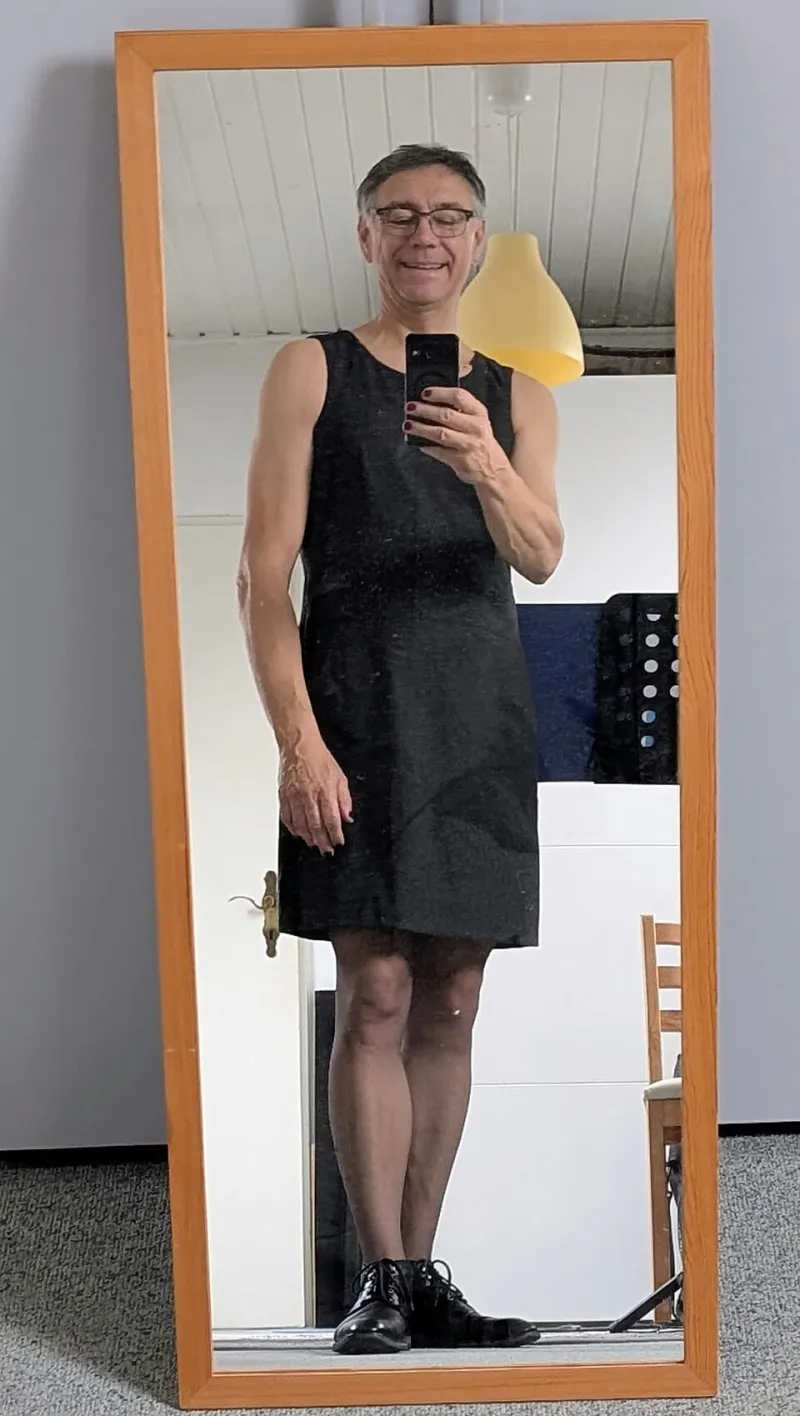
Second, a mirror at true eye level, hung flat, with no tilt at all. Unflattering, perhaps. Accurate, certainly.
Third, distance. A person standing half a metre from a mirror sees detail and misses proportion. At two and a half metres — the width of a small room — the eye takes in the whole silhouette at once, which is how the garment will actually be seen by everyone who is not standing in the doorway with you.
A Second Look From Across the Room
If there is one habit worth adopting from the fitting bench, it is this: dress, then walk away. Leave the garment on, cross the room, turn, and look back at it in the glass from the far side. The shoulder line will either hold or collapse. The hem will either sit level or reveal its bias. A sleeve that seemed correct at close range will show whether it hangs cleanly from the shoulder or twists.
This second look costs perhaps forty seconds and saves a great deal more than that in regret.
What to Do in a Room You Cannot Rewire
Shop staff will not rehang the mirror for you, but they will usually allow a garment to be carried to a window, and most stores have a stretch of floor where the light is better than in the cubicle. Ask. Take the coat to the daylight, hold it against you, and look at it in the glass of a shop floor rather than the box behind the curtain.
Failing that, buy on the understanding that the decision is provisional, and keep the tags on until the garment has been seen once at home, in the morning, in the light it will actually live in. A wardrobe built on a second look is a smaller wardrobe, and a better one.