The Unhurried Beginning: Airing a New Coat Before Its First Outing
There is a temptation, when a new coat arrives, to wear it at once. The parcel is opened, the tags are cut, and the garment is taken into the street before it has had time to recover from the journey. In the studio, we treat that first week differently. A coat is not merely unpacked; it is allowed to begin.
Airing is often mistaken for freshening, as though the aim were to replace one smell with another. It is closer to a period of adjustment. Cloth that has been pressed, folded, wrapped and carried arrives in a temporary state. The fibres have been held in one position; the lining has been compressed against the shell; the shoulders have known only the shape of a box. A short, unhurried spell on a good hanger gives the garment a chance to return to itself before it is asked to perform.
Why a new coat needs time
Wool is a living material in the sense that it responds to moisture, weight and rest. Its natural crimp gives it resilience, but that resilience is not instantaneous. A coat that has spent days in transit may show soft creases across the chest or a slight disturbance at the back of the sleeve. These are rarely faults. They are the memory of packing.
Tailoring adds another layer. A structured coat contains canvas, interlining, wadding and shoulder reinforcement. These materials need to settle together, not simply drop into place. The collar should find its roll; the fronts should hang without a ripple; the lining should sit quietly inside the cloth. None of this is helped by immediate wear, particularly in a British November, when a coat moves from a warm room to cold air and back again within the hour.
A week is not a rule so much as a useful interval. A lightweight cotton mac may need only a day or two. A dense melton, a flannel or a tweed overcoat benefits from longer. The principle is the same: allow the cloth to relax before the body imposes its own shape upon it.
The hanger does half the work
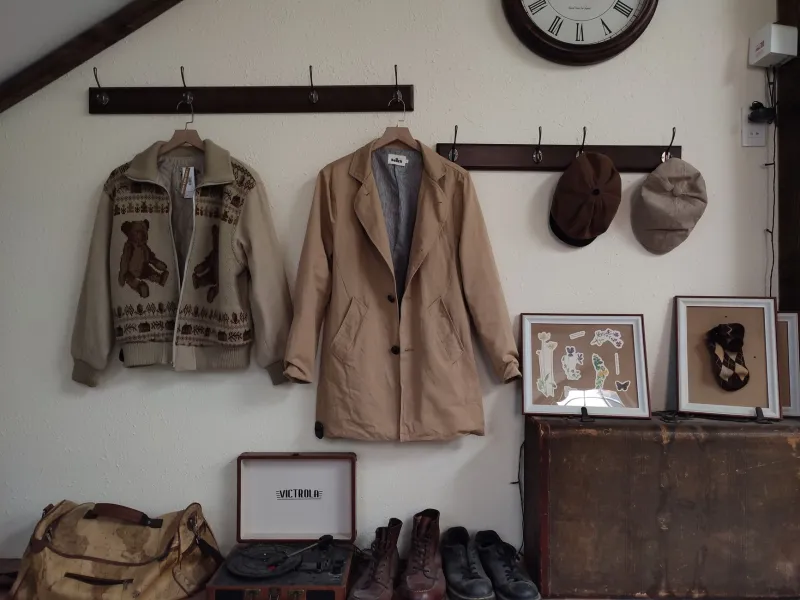
The first decision is the hanger, and it is more consequential than it appears. A new coat should not be left on a narrow wire hanger, nor on one that is too short for the shoulder. The aim is to support the garment from within, distributing its weight across the shoulder line rather than gathering it at two points.
A broad wooden hanger is the standard studio choice, though a well-shaped padded hanger can serve for softer coats. The hanger should follow the shoulder seam and sit fully inside the coat. If the shoulders slump over the ends, the hanger is too narrow. If the coat slides, it may be too smooth or too small. Heavier coats deserve a sturdy hook and a rail that will not bow under weight.
Hang the coat with the lining free to breathe. Fastening every button can hold the fronts in a pressed position when what they need is air; leaving the coat open allows movement through the lining and between the layers. A belt may be loosely tied or left hanging, but it should not be allowed to pull the coat out of shape.
Where to hang it in a British home
Airing is not simply a matter of finding a hook. The room matters. Choose a space with moving air and stable conditions: a hallway with a through draught, a spare bedroom with the window opened briefly each day, or a landing where air circulates without direct heat. The coat should be away from radiators, fires and strong sunlight, all of which can dry or fade cloth unevenly.
Damp rooms are the greater risk. A bathroom, a kitchen during cooking, or a utility room with condensation may feel convenient, but wool takes up moisture readily. A coat left in such a room can emerge smelling of the room rather than of itself, and the lining may feel cool and clammy. Wait for a dry day. If the only available space is a small flat, use a room that has been heated and then ventilated, and avoid sealing the coat into a plastic garment bag. Plastic traps moisture and any lingering odours. A cotton dust bag is for storage after the coat has settled, not for the airing itself.
Freshness is not fragrance
This is the point at which many well-meant routines go wrong. Airing is not the same as scenting. The purpose is to let the coat become neutral: to allow volatile residues from packaging, pressing and storage to disperse, and to let the cloth take on the dry, clean smell of moving air.
Perfume, scented sachets and cedar oil should not be applied at this stage. They mask rather than remove, and wool holds fragrance with unfortunate tenacity. A scent that seems faint on the hanger can become insistent when the coat is warmed by the body. Cedar may deter moths in storage, but it can also transfer its own note to the cloth. If a coat still smells after a week of proper airing, the cause is more likely to be damp or enclosed storage than a lack of fragrance.
A soft clothes brush is useful after airing, not before. Brush the cloth lightly to lift surface dust, check the pockets, and leave the coat to hang a little longer if the lining feels cold or the shoulders have not yet relaxed. The difference between a coat that has been aired and one that has merely been unwrapped is subtle, but it is visible in the fall of the front and the quietness of the collar.
A short schedule, not a ritual
In practice, the first day is for unpacking and inspection. Remove tags and packaging, brush lightly, and hang the coat on a suitable hanger in a well-ventilated room. For the next few days, leave it alone. Open a window briefly each morning if the weather is dry. Turn the coat on the rail once or twice so that air reaches both sides. On the seventh day, try it on indoors and look at the shoulders, the collar and the hem in a mirror. If the coat hangs cleanly, it is ready.
The wait is not an affectation. It is a small piece of tailoring care that belongs to the wardrobe rather than the workroom. A coat that has been allowed to settle will hang better, feel drier and reveal its fit more honestly. In a season that asks much of British cloth, that unhurried beginning is a sensible place to start.