The Waistband's Bargain: Structure, Give and the Trouser That Keeps Its Word
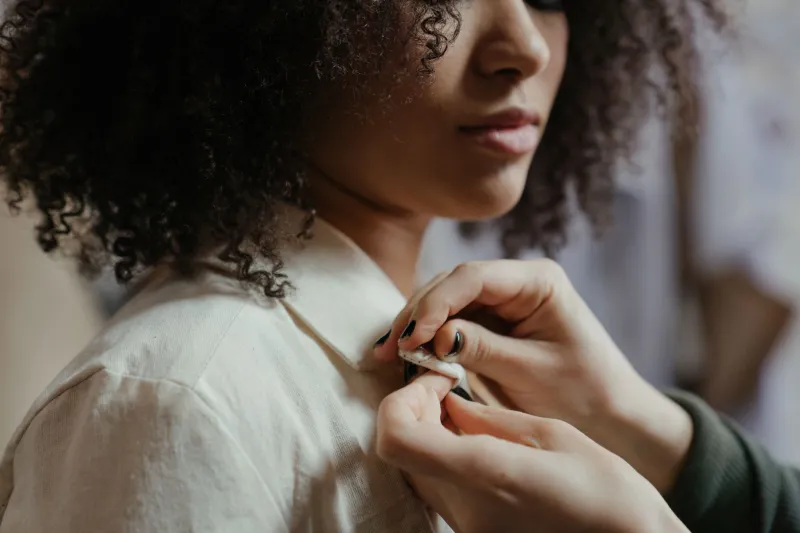
Of all the seams and edges that make a pair of trousers, the waistband is the one that negotiates most often. It meets the body at a point of constant change: seated, standing, climbing stairs, reaching for a rail on a crowded carriage, settling into a desk chair, or layering a jumper over a shirt. A waistband is therefore less a trim than a contract. It sets out what the garment will do when the body asks something of it, and how much it expects in return. The best examples keep their word without announcing the effort.
The Curve Before the Circumference
A waist is not a cylinder, and a waistband that treats it as one will always be making small corrections. The body rises and falls at the back, settles differently when seated, and changes shape under a knitted layer. A shaped waistband follows that geography, usually rising slightly at the centre back and curving through the side. A flat waistband is simpler to cut and press, and on some low-rise or softly constructed trousers it can be perfectly coherent. The question is not which is more fashionable, but which matches the rise, the cloth and the intended use.
A shaped band is not automatically superior. On a lightly constructed summer trouser, too much curve can create excess fabric at the side seam; on a firm woollen trouser intended for winter, a little shaping at the back helps the band stay close when the wearer sits. The fitting room should reveal whether the curve is doing real work or merely describing one.
Depth, Interlining and the Question of Roll
The depth of a waistband distributes pressure. A narrow band concentrates it; a deeper band spreads it across a broader area and can feel calmer under a belt or beneath a jumper. Depth also affects proportion. A deep band on a short rise can overwhelm the balance of the trouser, while a shallow band on a formal wool pair may look undernourished beside the cloth.
Interlining gives the band its composure. Without it, the cloth may collapse or twist; with too much, the band becomes a rigid hoop that stands away from the body and rolls at the top edge. The useful middle ground is a band that holds its line but yields when the wearer bends. Inside the waistband, look for clean attachment and a consistent curve. A band that curls before it has been worn is unlikely to improve with age.
Fastenings, Loops and Adjusters
Belt loops are practical and familiar, but they are not neutral. A belt adds a second structure at the waist, and that structure can be welcome over a shirt or disruptive under a close-fitting knit. Side adjusters offer a cleaner line and a more precise fit, particularly on formal trousers worn without a belt. They reward an accurate initial fit and punish guesswork; a side adjuster that pulls the band into a series of small ripples is doing more harm than good.
Neither solution is inherently better. Belt loops suit a trouser that will be worn with a jacket, a heavy knit or a casual shoe. Side adjusters suit a trouser that expects to be seen at the waist. The fitting room should include the layer that will actually be worn, because a waistband judged only against a shirt is only half judged.
Friction, Give and the Seated Day
Much of a waistband's working life is spent under friction. It rubs against a desk edge, a coat lining, a seat belt and the hem of a jumper. It also has to give: when the wearer sits, the band travels and the cloth behind it compresses. A band cut too close may feel impeccable while standing and become a quiet source of irritation after twenty minutes in a chair. Give should be engineered through seam allowance, pocket placement and a sensible fit, not hoped for through the natural stretch of the cloth.
Pocket bags and curtain matter here. A pocket bag that pulls against the band can distort its line; a well-placed pocket sits below the negotiation zone. The inside of the trouser is not a hidden country. It is the place where the contract is enforced.
Tests in the Fitting Room
- Sit for a full minute, not a perfunctory perch. Notice whether the band presses at the front, gaps at the back or rolls at the top edge.
- Breathe deeply and twist gently. The band should remain steady without feeling like a restraint.
- Wear the knitwear or jacket that will accompany the trousers. A waistband that works alone may fail in company.
- Check the back view when seated. A small gap may be acceptable; a wide opening is a sign that the curve or rise needs reconsidering.
- Run a thumb inside the band. It should feel smooth and consistent, with no twisted interlining or rough seam allowance.
- Walk a few paces and climb a stair. The band should stay in place without requiring a discreet tug.
The Contract Renewed
A waistband can be altered, let out or taken in, but every alteration renegotiates the terms. A good band survives this process because it was built with enough allowance and enough honesty. It does not promise that the trouser will never change; it promises that the change will be legible and manageable. In a British wardrobe, where one pair of trousers may meet a cold morning, a warm office and an early dusk, that is a sensible bargain. The waistband is not the most visible part of the garment, but it is often the part that decides whether the trouser is worn with confidence or with a quiet, recurring doubt.